
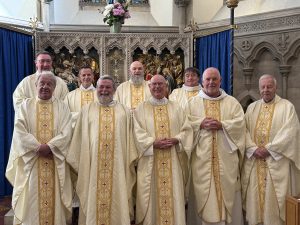
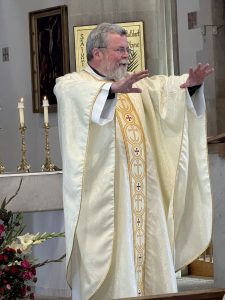
Monday 22nd September was annual Chapter Mass and dedication of the Cathedral together with the anniversary of the Restoration of the
Hierarchy, we would like to thank Cathdral parisioner Tom Healey for his account of the anniversary.
The Restoration of the Hierarchy 1850
The English Reformation destroyed Catholicism in England as it had existed from the 7th and 8th centuries when the church came together and developed. Government by the Pope was replaced by rule by the
monarch and a new national church was established. Article 37 of the Church of England stated that “the Bishop of Rome hath no jurisdiction in this Realm of England” and, by both implication and statute, anybody bearing allegiance to the “Bishop of Rome” was prima facie committing treason. Thomas More and Bishop John Fisher learned how costly such allegiance could be.
The Catholic Hierarchy was replaced by a Church of England Hierarchy with bishops and clergy swearing
loyalty to the monarch. Catholicism was In effect outlawed, its followers, if discovered or if they had the
temerity to declare their beliefs, punished by fines, imprisonment and, in extreme cases, by death. The latter fate befell priests as the fate of Cuthbert Mayne in this diocese attests.
Nevertheless this underground church continued to exist and operate. Dioceses and parishes ceased to exist but were replaced by clusters of believers assisted by travelling, fugitive priests. These priests were trained in seminaries on the continent, e.g. The Venerable English College in Rome, in Douai and Valladolid and sent in secret to England. These groups of clergy were directed by first, a series of Archpriests appointed by Rome and, from 1623 until 1850, Vicars Apostolic. From one Vicar Apostolic until 1688, the number rose to four and after1840 to eight each covering a distinct area of the country.
The increase in numbers of these prelates reflected the rise in the numbers of Catholics now living in England. These increases were due to large scale immigration from Ireland as the continuing wars with France resulted in significant numbers coming here to serve in the armed forces. By 1800 one third of the strength of the
army and navy comprised of recruits from Ireland. Refugees from other countries added to the number as did converts to Catholicism from the indigenous population. St John Henry Newman’s embracing of the faith prompted a number of others who followed his example.
The passing of the Catholic Emancipation Act of 1829 removed most of the legal obstacles to being a Catholic. This coupled with growing numbers, the massive influx of people from Ireland fleeing the Great Famine, led Vicars Apostolic and clergy to the conclusion that Catholicism must be placed on a properly organised footing. Already Pope Gregory XVI had come to this conclusion and in 1840 he doubled the numbers of Vicars
Apostolic to eight.
In 1847 Bishops Nicholas Wiseman and John Sharples went to Rome to negotiate with Pope Pius IX and the Roman Curia. Out of these negotiations emerged a proper diocesan structure and the beginnings of the
system we now recognise. The eight Vicars Apostolic were replaced by twelve dioceses each overseen by a bishop with boundaries redrawn to reflect the growth of the church in its various parts of the country. The West Country would have two dioceses, Plymouth comprising the counties of Cornwall, Devon and Dorset and Clifton embracing Gloucestershire, Wiltshire and Somerset.
The Hierarchy of England and Wales was formally promulgated by the Apostolic Letter Universalis Ecclesiae of Pope Pius IX on 29th September 1850. The first Bishop of Plymouth, George Errington was appointed on 16th June 1851 to be followed by eight successors in the years since. We celebrate the 175th anniversary of our diocese at the end of this month for which we pray Deo Gratias.